Mostrando entradas con la etiqueta 1st cycle ESO. Mostrar todas las entradas

jueves, 10 de abril de 2014

Celebrating Easter in the first cycle of ESO


My first ESO students do not really know that Easter is not celebrated in all parts of the world in the same way. That is the reason why we are going to watch this great video to see the differences between Spain and the UK. Topics such as the Easter hunt, the Easter bunnies or the Easter eggs are unkown to our students, so we will be working on that through the use of different worksheets found in this page called Activity Village

I hope you all have a Happy Easter!!!

jueves, 9 de enero de 2014

How to work on daily routines.


We are going to work on daily routines through these two videos, first we will watch the first and practice the vocabulary; we will also take the opportunity to make sentences and use the present simple tense. Then, we will watch the second one which is a short video about a girl's routine and we will try to write the sentences, maybe some other day we will use the Mozilla Popcorn Maker to write on top of the video what the girl does.

Some exercises to work daily routines and the present simple:


Did you like the activities proposed to practice the daily routines? What do you do in your classes?

jueves, 7 de noviembre de 2013

Who is who?

My Photo
@AnaGarciaTeacha
We have been working with the structure "have got" and the adjectives to describe people. We have described our best friends and we are going to describe our families next week. My students have been working really hard, so we are going to play Who is who to practise and have fun at the same time.

We will be working with different pages online:
I really think the best part of the day will be to play with our students, they choose a person in the class and answers "have got" questions so that the rest guess who he or she is thinking about.
What do you think of this activity?
Do you like it?

martes, 15 de octubre de 2013

Subject and verb agreement.


It is sometimes difficult for younger students to understand what is that thing called Subject and verb agreement, especially because at schools, we do not have enough time to practice on this. The ideal way would be to practise orally many times until they internalize it. Fortunately, we still have internet to practise on their own at home.
First, a brief explanation:


  • The person who speaks is the first person, singular (I) or plural (we, my sister and I, the students and I...)
  • The second person is the one who listens, it can be singular or plural (you, your friends and you, your brother and you...)
  • The third person is the one the first and second speak about: it can be singular male (he, Pete, my father...) or singular female (she, your sister, my mother...) or a thing or an animal, that is, singular neutral (it, my dog, the table...); it can also be plural ( they, my friends, Mary and Peter, my dogs, the chairs...
It is important that students understand well the relationships that are established in any conversation and their changing nature. The second step is to really learn how verbs work, we are going to focus on the two most usual verbs and the present simple this year in 1st of ESO, basically they will have to learn this chart:


V. to be
V. to have got
Present simple
I am
I have got
I (verb)
You are
You have got
You (verb)
He/she/it  is
He/she/it has got
He/she/it (verb)+s/es
We are
We have got
We (verb)
You are
You have got
You (verb)
They are
They have got
They (verb)

I am leaving some links to exercises so that you can practice:
I will work this with my class. I hope it helps. Do you master this?

jueves, 10 de octubre de 2013

What time is it?

It looks easy but it is not so much for students who do not know how to say the time in their own language. I hope this helps me and other teachers explain how to do it in an easy way. I made this infographic with a picture editor which you can find online and is free (except for some features) called PicMonkey, very easy to use.
In order to practise this issue, I strongly recommend the British page Teaching Time, with its demos Stop the Clock and Bang on Time, which students love.

So, what's the time?

lunes, 30 de septiembre de 2013

Burn-e, for 1st of ESO


Burn-e is a great short film by Pixar based on the film Wall-e, I am going to use it as a prize for my 1st ESO students. It is a very special group and they are making an effort to behave and learn more each day. I chose this film because the setting is well-known to students and there are not many words in English. I think they will enjoy it.

Have you watched it?
Did you like it?

domingo, 30 de junio de 2013

Getting ready for September... before going on holidays.

Página Moodle del IES Tartessos
Before we go on holidays, I want to introduce you the new page that the English Department at the Moodle platform. My mates have been working hard to upload the activities you can do during the summer to review English and pass the exam in September. They have already uploaded activities for 1st and 2nd ESO (both at the 1st ESO section of Moodle, just follow the link on top). When you enter the page, you have to register to get access, but it is very simple and in Spanish!
If you want to know the dates of the exams in September, you can also have a look at them at the official website of IES Tartessos, you have a summary of the English dates, all of them on the 2nd September:

1st language
2nd language
1st ESO
10h00
11h00
2nd ESO
11h00
10h00
3rd ESO
10h00
11h00
4th ESO
11h00
10h00
2ºPCPI
11h00
X
1st Bachillerato
8h00-9h45 (Hz 1&2)
9h45-11h30
2nd Bachillerato
9h45-11h30 (Hz 3&4)
X
All the ESO exams will last one hour and will be held in the SUM of the school. The bachillerato exams will last longer and will be held in Haza.

miércoles, 19 de junio de 2013

My students' work, part 4

2ºB's class
In the second term, we have worked on the Word of the Day project of which I have already told you. I show you some of the examples. For me, the most important thing is that my students get to expose their works in public and in English!! Thanks to all of them!!


Did you know these words??

domingo, 16 de junio de 2013

My students' work, part 3


We have been working in the second term on how to present and learn new vocabulary, so my students chose a word and explained it to their mates with the support, digital or not, that they wanted. On this day, @SergioVeil presented the word leader with the help of a powerpoint presentation.
What do you think of it?

jueves, 13 de junio de 2013

My students' work, part 2

Another infographic to present the uses of "There was/were", this one, done by Rocio with the Piktochart tool too. Congrats Rocio, good work!!

lunes, 10 de junio de 2013

My students' work. Part 1.

Around the world in 80 days
We are finishing the course, and it is true that we, teachers have worked a lot, but I am very happy to say that some of our students have worked hard too. I am going to present you some of the works that my students have done, starting with @Nerea_Lobo and @MariaAlonso1998. They accepted the challenge of imagining how Phileas Fogg would travel today and also of using a digital tool to present it, you can see the result on top, and if you press the link, you see it completely. Good work girls!!!
What do you think of their work? 
Please leave your comments and say!!

martes, 4 de junio de 2013

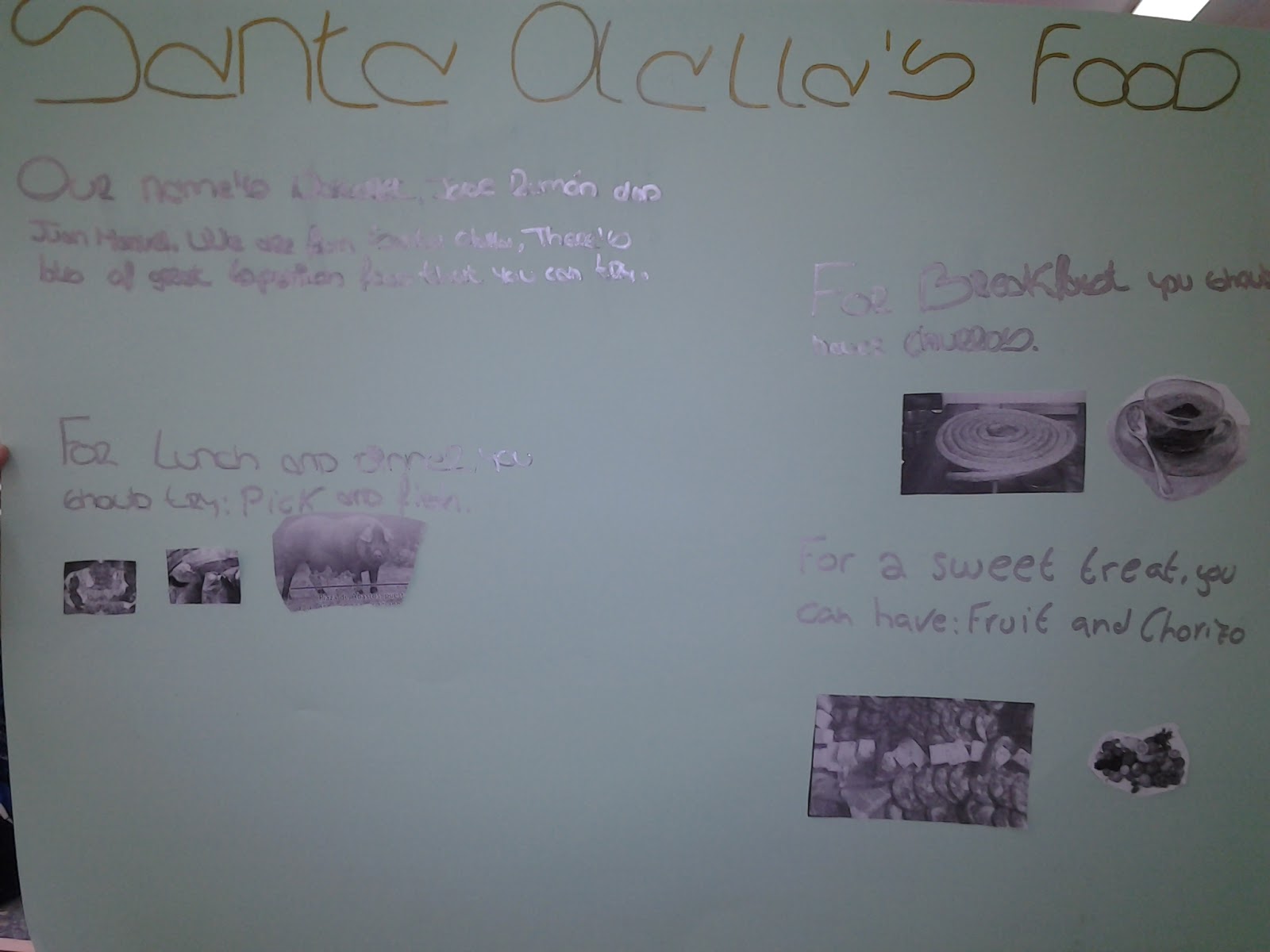
My place's food project

We have been working on food and recipes and verbs and everything which has to do with that, we have been very, very hungry. We decided that we would not make the composition that comes in the textbook, but that we would make posters with the food of the place that they chose, and here we have the results:


Are you hungry now?
As we do not have much place on our class' walls, we will see them here ;-P

domingo, 26 de mayo de 2013

The future in 2nd of ESO

Lake Supérieur, by Ana Garcia.
We are going to work on the structure "be going to+infinitive" to talk about plans and intentions in the near future. It is very simple, you only have to remember to use the correct form of the verb to be and write the infinitive form after "to".

Remember that we also use the present continuous to talk about fixed plans, plans that have been arranged.

You can practice more:
  • Going to structure in the affirmative, negative and interrogative at Ego4you
  • Games on going to at mes-games
  • Revision of present continuous and difference between present continuous and going to at English Exercises.
I hope it helps!!!


sábado, 11 de mayo de 2013

Learning vocabulary: Cooking with Jamie Oliver

In this unit, we are reviewing food and how to talk about it. We are also introducing the vocabulary you need to talk about the process of cooking (add, bake, boil, chop, fry, grate, grill, mix, peel, pour, put, season, slice  and wash).
 Many of these words appear on this video by Jamie Oliver, one of the most famous cooks in the UK at the moment. He has done many  TV programmes and is famous also for promoting quick healthy meals almost anyone can do in less than half an hour.

What verbs of the bold list does he actually say?
Do you think it is an easy dish to do? Would you like giving it a try?

If you want to read about how to talk about quantities and food go to this and this post.

domingo, 28 de abril de 2013

Football vocabulary

British Council
We have already seen the difference between football and soccer in this blog. Today I present you with a great collection of games and exercises on football vocabulary. Many of my students are great football players so I recommend you to learn this new vocabulary on the field, the players, the clothes, the equipment, the vocabulary the referees use in the field, the one used by the supporters, cup competitions or even the English teams to which you may go in the future.

Do you like football? Then, give it a try!! ;-))

martes, 16 de abril de 2013

How would you travel around the world?

Forbes
These days we are reviewing the different means of transport. My mind flew back to the book Around the World in 80 Days by Jules Verne. In this novel, Phileas Fogg takes a bet on travelling around the world in only 80 days at the end of the 19th century. Have you read this book?
I was wondering, how would this English gentleman do his trip nowadays? What countries would he visit? What forms of transport would he choose? How long would it take him to do this trip?
 I have a challenge for you: Imagine what his travelling plan would be and present it with a PowerPoint or Prezi presentation or, if you prefer, an infographic (you can do one with Piktochart) When you have done it, link it to Twitter and write my name @AnaGarciaTeacha in the tweet. I will choose the best and present them here in the blog. Remember to use the preposition "by"to introduce the means of transport and the different verbs that express movement in any of these transports.
 If you have any questions, do ask in the comments or in class. This hard work will be gratified in the final marks, of course.

sábado, 13 de abril de 2013

Model composition: Who was Sara Montiel?

Sara Montiel together with James Dean (photo taken from Rohmerin's blog)
Just five days ago, two very well-known women (for different reasons) died on the 8th April. The two of them may be quite unknown for our students, one of them was Margaret Thatcher and the other was Sara Montiel. We can take advantage of this and practice the past simple to talk about life events, as we did with Jane Austen or Frida Kahlo.

Sara Montiel was born as Mª Antonia Abad in Campo de Criptana in 1928. When she was just 15 years old, she took part in a talent show and won. She started making films in Spain and, very soon, she decided to go to America to start making films there. In 1954, she made her first Hollywood film called Veracruz with  very big actors like Gary Cooper. She came back to Spain and became a great diva and star.
At the beginning of the 1970s, she decided to stop making films in Spain and dedicated her work to singing. She has been married four times, the first in California, the second in Rome, the third in Palma de Mallorca with her great love, Pepe Tous, with whom she adopted two children and the fourth a few years ago with a Cuban men much younger than her.
Sara has sung together with her own son and other Spanish artists and has conducted two TV programmes in Spain. She wasn't ill and her death took everybody by surprise even though she was 85 years old.

Did you know her? Have you seen any of her films?

miércoles, 3 de abril de 2013

Reference words: Personal pronouns and adjectives.

Wordle: PRONOUNS
wordle
When reading a text or writing it, we must be aware of how important it is to understand and establish quality relationships between its words, that is, we have to make a good work with reference words. In this post, I will only deal with subject and object personal pronouns, the possessive adjectives and possessive pronouns.
There are some aspects that we should always remember:
  • Pronouns substitute nouns, adjectives do not!
  • Depending on "the job"of the noun, it should be replaced by a subject (before the verb) or object pronoun (after verbs or prepositions).
  • Possessive adjectives say who owns the noun, whose it is.
  • Possessive pronouns say who owns what has already been mentioned and are not accompanied by a noun.
If you want to see a very clear chart of these reference words go to Teaching English by Fran.
When you are ready to practice on this, visit the following:
Are you ready to work? Any problems? 
Leave a comment if you need for help or anyhting you want ;-)

jueves, 28 de marzo de 2013

There is/ There are...shown in an infographic

Picktochart
My first infographic,  I used Piktochart, completely free and very easy to use; the only problem I had is to export it. I am really looking forward to my students using it...
Do you like the result?

lunes, 25 de marzo de 2013

Practising English with Apps 4: Irregular verbs 2

Irregular verbs 2
Now that we are on holidays, we are going to continue with the apps' series. This time, I am presenting you one to learn English irregular verbs. When you open the menu, you find a list of the verbs which are in the game and you can listen to the three forms (base, past and past participle). You also find an Options button, if you click there, you can change the amount of verbs you want to play with in each game.

 You find the game by clicking on the Practice button. You see three chests and one of the three forms of the irregular verb; you also see four keys accompanied by the other two forms and other similar ones; besides, you can listen to the three forms if you do not remember them. You click on Check and you see if you are right; at the end of the game you can replay the wrong ones only, so that you can learn them better.

What do you think of this app? I think it is very good, especially for the first cycle of ESO because it does not have many verbs.

Practising English with Apps.

Ever Never Just For Since Still Already Yet

Helpdesk2den My first of bachillerato students have asked me for a chart to have a clear view of the time expressions used with the present ...