Mostrando entradas con la etiqueta learning to learn. Mostrar todas las entradas

martes, 15 de octubre de 2013

Subject and verb agreement.


It is sometimes difficult for younger students to understand what is that thing called Subject and verb agreement, especially because at schools, we do not have enough time to practice on this. The ideal way would be to practise orally many times until they internalize it. Fortunately, we still have internet to practise on their own at home.
First, a brief explanation:


  • The person who speaks is the first person, singular (I) or plural (we, my sister and I, the students and I...)
  • The second person is the one who listens, it can be singular or plural (you, your friends and you, your brother and you...)
  • The third person is the one the first and second speak about: it can be singular male (he, Pete, my father...) or singular female (she, your sister, my mother...) or a thing or an animal, that is, singular neutral (it, my dog, the table...); it can also be plural ( they, my friends, Mary and Peter, my dogs, the chairs...
It is important that students understand well the relationships that are established in any conversation and their changing nature. The second step is to really learn how verbs work, we are going to focus on the two most usual verbs and the present simple this year in 1st of ESO, basically they will have to learn this chart:


V. to be
V. to have got
Present simple
I am
I have got
I (verb)
You are
You have got
You (verb)
He/she/it  is
He/she/it has got
He/she/it (verb)+s/es
We are
We have got
We (verb)
You are
You have got
You (verb)
They are
They have got
They (verb)

I am leaving some links to exercises so that you can practice:
I will work this with my class. I hope it helps. Do you master this?

sábado, 21 de septiembre de 2013

Mens sana in corpore sano

Couch-to-5K
I decided a few months ago that I had to take more care of my own body because it will be "my home" for all of my life. As I get older; I realize how important it is to be healthy and to have a toned body that is able to do whatever I want it to do.
I have taken up running and I want to participate in a race in the near future. That is the reason why I downloaded this app, it is called Couch to 5K (1.51€) and that is literally what it tries to do: take a person from the sofa to running 5 kilometers in nine weeks of controlled training. At the beginning of the training you walk more than run and this is the opposite at the end of the nine weeks.
It is completely in English (very simple and clear vocabulary) and you can also listen to music from playlists that you can create or import. So, I strongly recommend it to my students, they can listen to English songs and improve their listening skills while running, a healthy mind in a healthy body.
What do you think of making exercise?
Do you think using apps for training sports is a good idea?

miércoles, 19 de junio de 2013

My students' work, part 4

2ºB's class
In the second term, we have worked on the Word of the Day project of which I have already told you. I show you some of the examples. For me, the most important thing is that my students get to expose their works in public and in English!! Thanks to all of them!!


Did you know these words??

domingo, 16 de junio de 2013

My students' work, part 3


We have been working in the second term on how to present and learn new vocabulary, so my students chose a word and explained it to their mates with the support, digital or not, that they wanted. On this day, @SergioVeil presented the word leader with the help of a powerpoint presentation.
What do you think of it?

jueves, 13 de junio de 2013

My students' work, part 2

Another infographic to present the uses of "There was/were", this one, done by Rocio with the Piktochart tool too. Congrats Rocio, good work!!

lunes, 10 de junio de 2013

My students' work. Part 1.

Around the world in 80 days
We are finishing the course, and it is true that we, teachers have worked a lot, but I am very happy to say that some of our students have worked hard too. I am going to present you some of the works that my students have done, starting with @Nerea_Lobo and @MariaAlonso1998. They accepted the challenge of imagining how Phileas Fogg would travel today and also of using a digital tool to present it, you can see the result on top, and if you press the link, you see it completely. Good work girls!!!
What do you think of their work? 
Please leave your comments and say!!

martes, 4 de junio de 2013

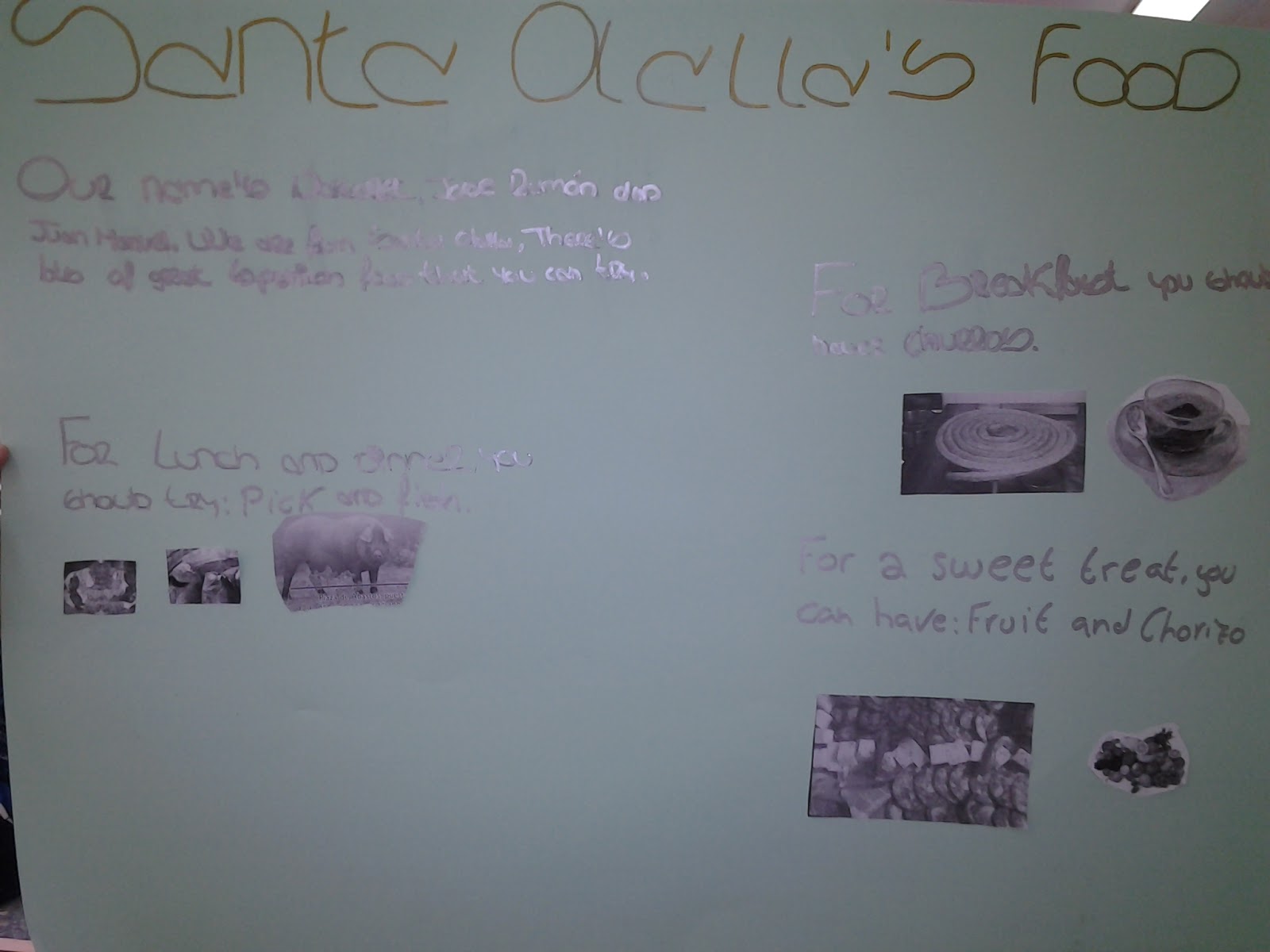
My place's food project

We have been working on food and recipes and verbs and everything which has to do with that, we have been very, very hungry. We decided that we would not make the composition that comes in the textbook, but that we would make posters with the food of the place that they chose, and here we have the results:


Are you hungry now?
As we do not have much place on our class' walls, we will see them here ;-P

jueves, 23 de mayo de 2013

My first MOOC.

Coursera
I am going to show you my last new adventure (two in a week, not a bad one, is it?). On Monday I started my first MOOC, it stands for Massive Open Online Course and they are online courses proposed by prestigious universities which are held online for thousands of people.

The course I am taking is called "Tecnologías de información y comunicación en la educación" and it is from the University of Mexico. It started on Monday and it finishes on the 23rd June and the work is divided into 5 weeks at the end of which we, the students, will have to have read some documents and fill in an autoevaluation test. There are also forums and 5 live sessions on YouTube. We also have a hashtag on Twitter: #ticunam

At the end of the course, our final project will be evaluated by 5 mates of the course and that result (80%)  together with the sum of the autoevaluations (20%) will be our final result. We are recommended to write a blog with our personal thinkings which I will link when I have something written, it is called Formación Docente (fuera de horario).

I think MOOCs are a perfect way to develop a personal learning environment for teachers for some reasons:

  • We do have time and willingness to learn; but certainly we cannot take lessons in the morning or the afternoon.
  •  We can choose among thousands of courses from all around the world which will certify our learning. 
  • We get certified for free (which is excellent now that our pays are getting reduced). 
  • We get to create a network of professional teachers who have the same worries and interests...

Have you ever taken part in one? Share your experience with us and wish me good luck!

domingo, 28 de abril de 2013

Football vocabulary

British Council
We have already seen the difference between football and soccer in this blog. Today I present you with a great collection of games and exercises on football vocabulary. Many of my students are great football players so I recommend you to learn this new vocabulary on the field, the players, the clothes, the equipment, the vocabulary the referees use in the field, the one used by the supporters, cup competitions or even the English teams to which you may go in the future.

Do you like football? Then, give it a try!! ;-))

domingo, 7 de abril de 2013

Practising English with Apps 5: Irregular verbs Sergeev Sergey

Google Play Store
Today I want to present you another app related to the learning of the irregular verbs, I have thought that this one is better for students of Bachillerato, rather than the other one I presented which is for younger students, or even for adults who want to review them.
This app has a much more serious interface and many more verbs, we can start reviewing verbs right away or we can open the menu in which we have 4 possibilities:
  1. Word groups: we can set the app to work on different types of groups of verbs in terms of difficulty or different  coincidences in the forms of the verbs.
  2. Word list: you can choose the verbs you want to work on.
  3. Preferences: you can set limits of time or number of questions and other settings.
  4. Additional: here you find additional information on the author and about the paid version.
The dynamics is very simple, when you start, a verb in Spanish appears together with three gaps for the base, the simple past and the past participle forms; you can type directly the answers, however, you can also listen to it, choose from 4 different options or directly check the answer of a particular form. At the end, you are given a percentage of right answers.

What do you think of this app? Do you prefer this one or the other one (Irregular verbs 2)?
Leave a comment and tell us!


lunes, 25 de marzo de 2013

Practising English with Apps 4: Irregular verbs 2

Irregular verbs 2
Now that we are on holidays, we are going to continue with the apps' series. This time, I am presenting you one to learn English irregular verbs. When you open the menu, you find a list of the verbs which are in the game and you can listen to the three forms (base, past and past participle). You also find an Options button, if you click there, you can change the amount of verbs you want to play with in each game.

 You find the game by clicking on the Practice button. You see three chests and one of the three forms of the irregular verb; you also see four keys accompanied by the other two forms and other similar ones; besides, you can listen to the three forms if you do not remember them. You click on Check and you see if you are right; at the end of the game you can replay the wrong ones only, so that you can learn them better.

What do you think of this app? I think it is very good, especially for the first cycle of ESO because it does not have many verbs.

Practising English with Apps.

domingo, 10 de marzo de 2013

The little chick cheep


In these days, things around myself are getting too serious, so I feel like doing something not serious at all.
This video is very funny, I see my students smiling when they watch it, specially at the  end of it, that is why I would like to share it here.
Nevertheless, it is also a fun way of learning of vocabulary by the repetition of the words; on the one hand, we revise animals' vocabulary that my students already know; on the other hand, we get to learn the onomatopoeic sounds these animals make, which is new vocabulary. I have not found the lyrics in English but it is a very repetitive song which basically follows this pattern:
"On the radio there's a little (name of animal) and the (name of animal) (name of onomatopoeic sound)
and the (name of animal) (name of onomatopoeic sound)
On the radio there's a little (name of new animal) and the (name of old animal) (name of onomatopoeic sound of the old animal)..."
Names of the animals and sounds in order:
chick->cheep, hen->co-co, cock*->doodle doo, turkey-> gobble-gobble, pigeon-> cru-cru, cat-> mew, dog-> woof, goat-> mah, lamb-> bah, cow-> moo, bull->muu, tractor-> brumm.

This songs cheers me up and I hope it also works with you, all the students working for final exams and all the teachers who work hard day by day.  Do you like it? Does it cheer you up?

 *This can also be a rude word, be careful!

viernes, 1 de marzo de 2013

Practising English with Apps 3: ML Phrasal Verbs

ML Phrasal Verbs
This is the third of the series of Apps I am presenting you, you can have a look at the other two here. I think this is a great app to have in your mobile device and use it every now and then. As you know, I hate lists as a way of learning vocabulary, but I do think repetition is a good way to learn new words if there is some kind of reelaboration and this app is great for that.

In the main menu, we have two different parts:
  • Reference.
  • Phrasal Verbs Games.
In the Reference part, there is a list of up to 1,063 phrasal verbs with their meaning in English, an example and the translation to Spanish. There is a star next to each phrasal verb so that you can make your own list of phrasal verbs (just in case you need to revise some for an exam, for example), it is difficult to click on the star, though.

In the Phrasal Verbs Games part, we find three different types of games:
  1. Verb by Meaning: you have the phrasal verb and an example and you have to choose a synonym phrase or word in English.
  2. Meaning by Verb: you have the synonym phrase or word and you have to choose the phrasal verb (no examples in this one).
  3. Anagram: This is my favourite!! There are disordered letters on screen that you have to put in the correct order to form 2 or 3-word phrasal verbs. If you press the word CUE, you get a synonym word or phrase. I like this one because I think it gets our brains to think which word can it be with the letters you see and I think that mechanism in the brain makes it easier to remember the phrasal verbs.
This is a very goog way of learning phrasal verbs and it is totally free, (you get ads, but they do not interfere with the game), so I strongly reccommend it. You can download it through the link under the picture and have fun!!!

viernes, 25 de enero de 2013

Learning vocabulary: Numbers

Astonishingly enough, that is, to my surprise, many of my students do not know how to read numbers, so every time we come across one in a sentence they start sweating and wait for my help so that they can read it properly; this does not usually happen with dates which are divided into pairs to be said, for example: 1976 is read "nineteen seventy-six" and, normally, there is no problem. But when it comes to figures...
That is why I have decided to write this post so that you eventually get to know them. The first chart shows the main patterns:
1
10
100
1,000
10,000
100,000
1,000,000
One
Ten
A hundred
A thousand
Ten thousand
A hundred thousand
A million
Important things to remember:
  • When saying numbers, we do not use the plural of hundred, thousand or million. They only use it in the plural when they talk about an indefinite quantity (for instance, "there were hundreds of animals before me", is it two hundred, three?, we do not know)
  • They use commas instead of points, they use points for decimals.
  • You have to use "and" to link hundred, thousand or million to tens or units.
  • They can use a or one before million, hundred and thousand but not in any other position.
Let's see some examples:
7
14
178
2,259

18,654


589,236


6,789,541
Seven
Fourteen

A hundred and seventy-eight

two thousand, two hundred and fifty-nine.

Eighteen thousand, six hundred and fifty-four

Five hundred and eighty-nine thousand, two hundred and thirty-six

Six million, seven hundred and eighty-nine thousand, five hundred and forty-one.
Now it is your time to work on it, check out the following links:
I hope the post gives you a clear idea of what you should be doing when you read numbers.

PS: I will not publish the comments on the animal description post until Monday, so more of you get the opportunity to do it. Good work!

martes, 22 de enero de 2013

Learning vocabulary: Animals' descriptions

Knuthenborg Safaripark, Denmark
In order to improve our vocabulary, one of the best ways is to use new words or expressions in context. There are many activities to do so, I am going to present you one I like doing in my classes.

 When talking about animals, we can teach all the vocabulary related to where they live (geographical features, countries, continents...), what they eat (smaller animals, plants, insects...), the parts of their bodies (beak, tail, wings, legs, arms, feathers, fur, colours...), what they can or can not do (swim, jump, crawl, fly...), their colours and special features (endangered species, use for humans, superlatives ...) and then make our students use it in context.

 I really like to play guessing games with short descriptions of animals; that is, first you give them a model to write a short description of an animal. It is important to let them choose the animals. Then you give them some minutes to choose an animal and write down a short description following the model, then students read out loud and the rest guess the animals.
 
Model composition for oral expression game:

It is a/an (amphibian, mammal, bird, reptile, fish).
It is (colours) and it has got (parts of the body).
It lives in (place).
It can/ can not (verbs).
 
Do you know what is the name of the animal in the photo? Can you make a short description of it? Please try and send your description in a comment!!


miércoles, 19 de diciembre de 2012

Practising English with Apps 2: Johny Grammar's Quiz

British Council

As I told you, I am going to show you another app . It is called Johny Grammar's Quiz. This is a very fun and entertaining app also designed by British Council. In this app, you can practice things we see in class in a very easy way. You have a menu subdivided into three:
  1. Spelling quiz
  2. Grammar quiz, and
  3. Vocab quiz
In the spelling quiz, there are two stages: in the first one you say which word is correct; and in the second one, you have to point out the one that is wrong and rewrite it again correcting it. The grammar and vocabulary quizzes are divided into three different levels: easy, medium and hard. The grammar quiz has got four different cattegories depending on the level you choose, for instance modals or conjunctions (on the hardest level), infinitives or gerunds (medium level) and irregular verbs (easiest level). The vocabulary quiz has got ten different categories including phrasal verbs, idioms, food, small talk and so on.

You can practice for hours with this free app for Android. You can also enjoy yourself at the same time. Try it and tell us!! Please, those of you who downloaded the Wordshake app and are literally hooked on it, leave your comments so that your mates know it is true!!

Remember, if you like the blog or this post and think others will like it too, they will find it easier if you push the g+ bottom below or on top right. Thanks!!!

sábado, 15 de diciembre de 2012

Practising English with Apps 1: Wordshake.

British Council
In a few days (just 5!!!), we will have much more free time. That is the reason why I am presenting  you this new serie of posts: Practising English with Apps.  In this serie, I am going to show you apps that I have come across and that I think are very good to practise English in a fun and entertaining way and/or apps that treat a specific issue, such as vocabulary, grammar...

I am starting today  with Wordshake, this is a free app that you can find at Google Play and it consists of building words of more than three letters with 6 or 9 random letters in a given time (1 or 3 minutes) depending on the level you choose. You get more points the longer the words are. This is a fun way to learn new vocabulary because when you finish, the app makes a list of the words you built but also of all the possibilities that you had, so you see many new words or revise many that you already know but did not have the time to see.

It is quite fun and takes so few time that you can play with it almost everywhere!!
Do download it!! Then, tell me, how many points did you get?

If you liked this post and/or the blog, please remember to g+ at the top right of the page so that more people get here!!! Thanks!!!

sábado, 10 de noviembre de 2012

Be used to, get used to; I used to know these things


While you are listening to this fantastic song by Gotye (there are some mistakes in the Spanish translation), you can have a look to the explanation in the chart below about these three quite similar terms; there is another good explantion at Peter's Blog inglés (in Spanish).You can also do the  exercises I am going to propose you.
USED TO DO (INFINITIVE)
GET USED TO DOING (GERUND)
BE USED TO DOING (GERUND)
Past habit or state

Process of acquiring a habit
Actually having the habit.

Verb in personal form (used to changes), already in the past:


I used to eat a lot.
I didn’t use to eat a lot.
Did  you use to sleep a lot?
Verb in the infinitive, we can find it in present, past or future (used to remains unchanged):

I got used to eating little.
I didn’t get used to eating so little.
Did you get used to eating so little?
Verb in the infinitive, we can find it in present, past or future (used to remains unchanged):

I was used to eating little.
I wasn’t used to eating little.
Were you used to eating so little?


You can practise this at the following pages:

So, tell me, are you getting used to using the blog to study English?
Leave your comments!!

miércoles, 17 de octubre de 2012

PRESENT SIMPLE OR PRESENT CONTINUOUS?

Grammar Goddess
My 1st of Bachillerato students have asked me to do a chart on the differences of use between the present simple and the present continuous, so, browsing through the internet I found  this wonderful mindmap in a blog called Grammar Goddess (fantastic way to remember grammar issues!!). In this picture, we find the affirmative, negative and interrogative forms of the verbs in the present simple, plus the verb to be and the different uses; we have also seen in class the use of present simple for timetables and schedules.

So, here is the chart you were asking me for:

Present simple

Present continuous
  •             Habits or routines (with frequency adverbs and expressions)
  •             General truths or facts
  •          With timetables and schedules.
  •             With state verbs  (feelings, opinions, mental processes, states, posession, senses and measures)
  •         At the moment of speaking.
  •           Ongoing activities.
  •        Temporary situations.
  •            Fixed plans of the near future.
  •              Annoying habits (usually with “always”)


If you need some more practice, go here:
I have done what you wanted, now I'm asking you something: Can you do a mindmap with the present continuous? Please!! If you can, hand it in and we will publish it here. 
As always, leave your comments!!

jueves, 11 de octubre de 2012

Learning vocabulary: diagrams

Diagrams are symbolic representations of information, they are a mixture of pictures and letters organized in a way that they  visualize  information. We usually use diagrams in science classes, but they are a great way to study vocabulary, especially if they are our students' own creations. The one above, which I created for my 2nd year classes, makes it easier for them to remember the contents: verbs that express likes and dislikes have to be followed by the verbs in the gerund (v+ing)

You can practise this structure at English Exercises or at The English Corner by Eva Casals.

We usually use diagrams for vocabulary, like that of the parts of the body or the house, but we should encourage our students to use them for vocabulary and grammar purposes, it is a good way to make their brains work and this will help them to remember the contents more easily.

Do you like diagrams? Do you use them in your classes?
Leave your comments and tell us!!

Ever Never Just For Since Still Already Yet

Helpdesk2den My first of bachillerato students have asked me for a chart to have a clear view of the time expressions used with the present ...