Mostrando entradas con la etiqueta vocabulary. Mostrar todas las entradas

jueves, 9 de enero de 2014

How to work on daily routines.


We are going to work on daily routines through these two videos, first we will watch the first and practice the vocabulary; we will also take the opportunity to make sentences and use the present simple tense. Then, we will watch the second one which is a short video about a girl's routine and we will try to write the sentences, maybe some other day we will use the Mozilla Popcorn Maker to write on top of the video what the girl does.

Some exercises to work daily routines and the present simple:


Did you like the activities proposed to practice the daily routines? What do you do in your classes?

miércoles, 19 de junio de 2013

My students' work, part 4

2ºB's class
In the second term, we have worked on the Word of the Day project of which I have already told you. I show you some of the examples. For me, the most important thing is that my students get to expose their works in public and in English!! Thanks to all of them!!


Did you know these words??

domingo, 16 de junio de 2013

My students' work, part 3


We have been working in the second term on how to present and learn new vocabulary, so my students chose a word and explained it to their mates with the support, digital or not, that they wanted. On this day, @SergioVeil presented the word leader with the help of a powerpoint presentation.
What do you think of it?

martes, 4 de junio de 2013

My place's food project

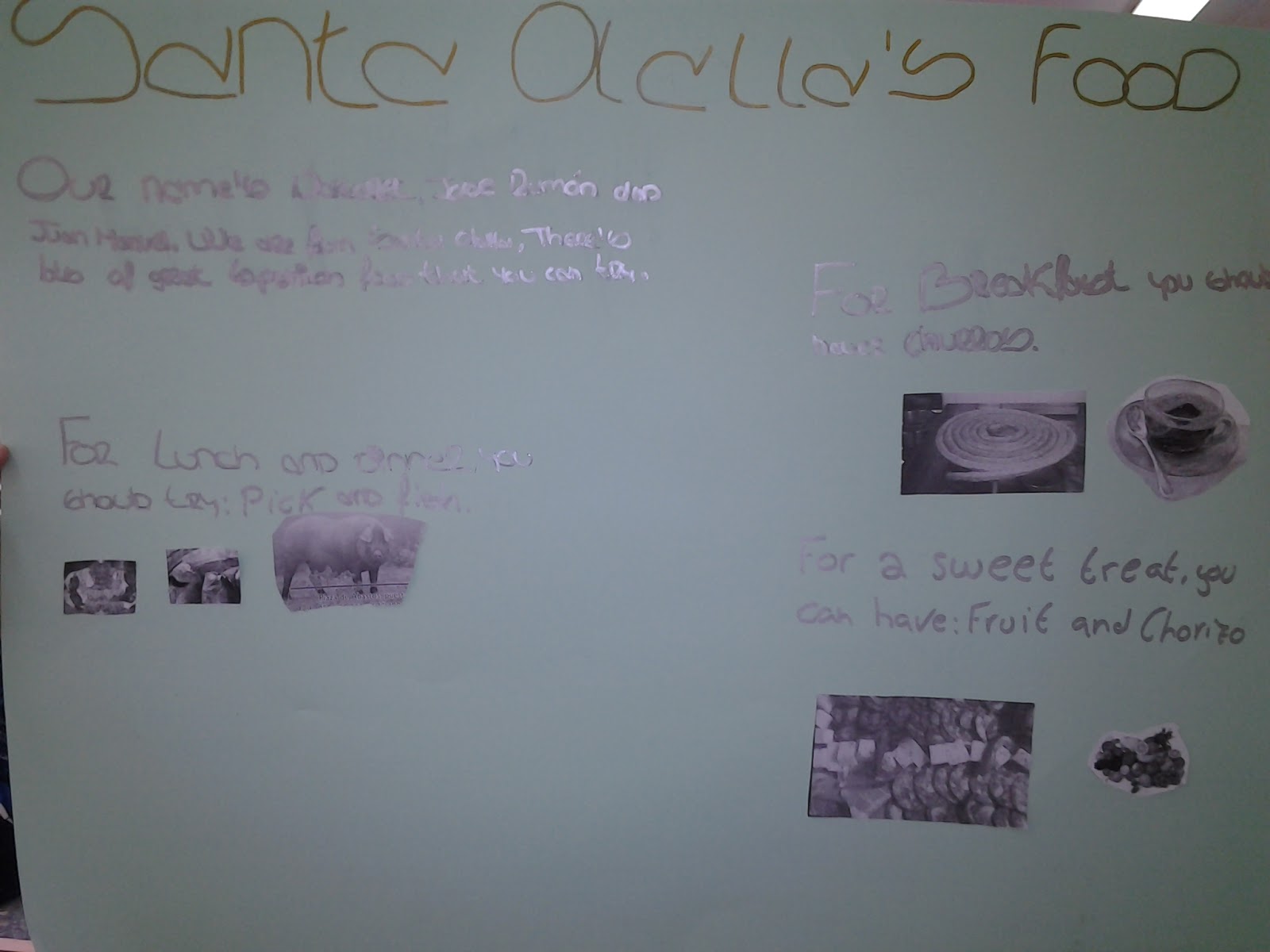
We have been working on food and recipes and verbs and everything which has to do with that, we have been very, very hungry. We decided that we would not make the composition that comes in the textbook, but that we would make posters with the food of the place that they chose, and here we have the results:


Are you hungry now?
As we do not have much place on our class' walls, we will see them here ;-P

sábado, 11 de mayo de 2013

Learning vocabulary: Cooking with Jamie Oliver

In this unit, we are reviewing food and how to talk about it. We are also introducing the vocabulary you need to talk about the process of cooking (add, bake, boil, chop, fry, grate, grill, mix, peel, pour, put, season, slice  and wash).
 Many of these words appear on this video by Jamie Oliver, one of the most famous cooks in the UK at the moment. He has done many  TV programmes and is famous also for promoting quick healthy meals almost anyone can do in less than half an hour.

What verbs of the bold list does he actually say?
Do you think it is an easy dish to do? Would you like giving it a try?

If you want to read about how to talk about quantities and food go to this and this post.

domingo, 28 de abril de 2013

Football vocabulary

British Council
We have already seen the difference between football and soccer in this blog. Today I present you with a great collection of games and exercises on football vocabulary. Many of my students are great football players so I recommend you to learn this new vocabulary on the field, the players, the clothes, the equipment, the vocabulary the referees use in the field, the one used by the supporters, cup competitions or even the English teams to which you may go in the future.

Do you like football? Then, give it a try!! ;-))

martes, 16 de abril de 2013

How would you travel around the world?

Forbes
These days we are reviewing the different means of transport. My mind flew back to the book Around the World in 80 Days by Jules Verne. In this novel, Phileas Fogg takes a bet on travelling around the world in only 80 days at the end of the 19th century. Have you read this book?
I was wondering, how would this English gentleman do his trip nowadays? What countries would he visit? What forms of transport would he choose? How long would it take him to do this trip?
 I have a challenge for you: Imagine what his travelling plan would be and present it with a PowerPoint or Prezi presentation or, if you prefer, an infographic (you can do one with Piktochart) When you have done it, link it to Twitter and write my name @AnaGarciaTeacha in the tweet. I will choose the best and present them here in the blog. Remember to use the preposition "by"to introduce the means of transport and the different verbs that express movement in any of these transports.
 If you have any questions, do ask in the comments or in class. This hard work will be gratified in the final marks, of course.

domingo, 10 de marzo de 2013

The little chick cheep


In these days, things around myself are getting too serious, so I feel like doing something not serious at all.
This video is very funny, I see my students smiling when they watch it, specially at the  end of it, that is why I would like to share it here.
Nevertheless, it is also a fun way of learning of vocabulary by the repetition of the words; on the one hand, we revise animals' vocabulary that my students already know; on the other hand, we get to learn the onomatopoeic sounds these animals make, which is new vocabulary. I have not found the lyrics in English but it is a very repetitive song which basically follows this pattern:
"On the radio there's a little (name of animal) and the (name of animal) (name of onomatopoeic sound)
and the (name of animal) (name of onomatopoeic sound)
On the radio there's a little (name of new animal) and the (name of old animal) (name of onomatopoeic sound of the old animal)..."
Names of the animals and sounds in order:
chick->cheep, hen->co-co, cock*->doodle doo, turkey-> gobble-gobble, pigeon-> cru-cru, cat-> mew, dog-> woof, goat-> mah, lamb-> bah, cow-> moo, bull->muu, tractor-> brumm.

This songs cheers me up and I hope it also works with you, all the students working for final exams and all the teachers who work hard day by day.  Do you like it? Does it cheer you up?

 *This can also be a rude word, be careful!

viernes, 1 de marzo de 2013

Practising English with Apps 3: ML Phrasal Verbs

ML Phrasal Verbs
This is the third of the series of Apps I am presenting you, you can have a look at the other two here. I think this is a great app to have in your mobile device and use it every now and then. As you know, I hate lists as a way of learning vocabulary, but I do think repetition is a good way to learn new words if there is some kind of reelaboration and this app is great for that.

In the main menu, we have two different parts:
  • Reference.
  • Phrasal Verbs Games.
In the Reference part, there is a list of up to 1,063 phrasal verbs with their meaning in English, an example and the translation to Spanish. There is a star next to each phrasal verb so that you can make your own list of phrasal verbs (just in case you need to revise some for an exam, for example), it is difficult to click on the star, though.

In the Phrasal Verbs Games part, we find three different types of games:
  1. Verb by Meaning: you have the phrasal verb and an example and you have to choose a synonym phrase or word in English.
  2. Meaning by Verb: you have the synonym phrase or word and you have to choose the phrasal verb (no examples in this one).
  3. Anagram: This is my favourite!! There are disordered letters on screen that you have to put in the correct order to form 2 or 3-word phrasal verbs. If you press the word CUE, you get a synonym word or phrase. I like this one because I think it gets our brains to think which word can it be with the letters you see and I think that mechanism in the brain makes it easier to remember the phrasal verbs.
This is a very goog way of learning phrasal verbs and it is totally free, (you get ads, but they do not interfere with the game), so I strongly reccommend it. You can download it through the link under the picture and have fun!!!

lunes, 25 de febrero de 2013

Simple past 3

Created with Wordle
In this unit we are talking about the past, what has happened to people in their lives, we are writing biographies, singing songs about the past, learning the past simple and past participle of irregular verbs...
To continue with that practise, I strongly recommend this worksheet by Cambridge University Press. You can have a look at the answers too.

viernes, 25 de enero de 2013

Learning vocabulary: Numbers

Astonishingly enough, that is, to my surprise, many of my students do not know how to read numbers, so every time we come across one in a sentence they start sweating and wait for my help so that they can read it properly; this does not usually happen with dates which are divided into pairs to be said, for example: 1976 is read "nineteen seventy-six" and, normally, there is no problem. But when it comes to figures...
That is why I have decided to write this post so that you eventually get to know them. The first chart shows the main patterns:
1
10
100
1,000
10,000
100,000
1,000,000
One
Ten
A hundred
A thousand
Ten thousand
A hundred thousand
A million
Important things to remember:
  • When saying numbers, we do not use the plural of hundred, thousand or million. They only use it in the plural when they talk about an indefinite quantity (for instance, "there were hundreds of animals before me", is it two hundred, three?, we do not know)
  • They use commas instead of points, they use points for decimals.
  • You have to use "and" to link hundred, thousand or million to tens or units.
  • They can use a or one before million, hundred and thousand but not in any other position.
Let's see some examples:
7
14
178
2,259

18,654


589,236


6,789,541
Seven
Fourteen

A hundred and seventy-eight

two thousand, two hundred and fifty-nine.

Eighteen thousand, six hundred and fifty-four

Five hundred and eighty-nine thousand, two hundred and thirty-six

Six million, seven hundred and eighty-nine thousand, five hundred and forty-one.
Now it is your time to work on it, check out the following links:
I hope the post gives you a clear idea of what you should be doing when you read numbers.

PS: I will not publish the comments on the animal description post until Monday, so more of you get the opportunity to do it. Good work!

martes, 22 de enero de 2013

Learning vocabulary: Animals' descriptions

Knuthenborg Safaripark, Denmark
In order to improve our vocabulary, one of the best ways is to use new words or expressions in context. There are many activities to do so, I am going to present you one I like doing in my classes.

 When talking about animals, we can teach all the vocabulary related to where they live (geographical features, countries, continents...), what they eat (smaller animals, plants, insects...), the parts of their bodies (beak, tail, wings, legs, arms, feathers, fur, colours...), what they can or can not do (swim, jump, crawl, fly...), their colours and special features (endangered species, use for humans, superlatives ...) and then make our students use it in context.

 I really like to play guessing games with short descriptions of animals; that is, first you give them a model to write a short description of an animal. It is important to let them choose the animals. Then you give them some minutes to choose an animal and write down a short description following the model, then students read out loud and the rest guess the animals.
 
Model composition for oral expression game:

It is a/an (amphibian, mammal, bird, reptile, fish).
It is (colours) and it has got (parts of the body).
It lives in (place).
It can/ can not (verbs).
 
Do you know what is the name of the animal in the photo? Can you make a short description of it? Please try and send your description in a comment!!


miércoles, 28 de noviembre de 2012

Learning vocabulary: Jobs

British Council
One of the best ways to learn vocabulary is by using it in context. We have been talking about professions and the work clothes and the equipment required to perform the different tasks.
I find that this game by British Council , a non-profit organization to develop British culture and language around the world, is a great opportunity to put in practice all this new vocabulary. 
The game consists in "dressing" the character with the clothes according to the information given in the red square, we also have to guess the character's job. This part maybe a little easy for our 2nd year of ESO students, but they love it!! The second part, which is not so easy and we could add as follow-up in class or at home is that they write a little description similar to the ones in the games and their mates have to guess the job. 

You have many different ways to practice jobs online:
It is a great opportunity to put the vocabulary in context and develop writing, reading and listening skills. What do you think of this idea? Do you like it?
Do you have any ideas for follow-up activities?

jueves, 11 de octubre de 2012

Learning vocabulary: diagrams

Diagrams are symbolic representations of information, they are a mixture of pictures and letters organized in a way that they  visualize  information. We usually use diagrams in science classes, but they are a great way to study vocabulary, especially if they are our students' own creations. The one above, which I created for my 2nd year classes, makes it easier for them to remember the contents: verbs that express likes and dislikes have to be followed by the verbs in the gerund (v+ing)

You can practise this structure at English Exercises or at The English Corner by Eva Casals.

We usually use diagrams for vocabulary, like that of the parts of the body or the house, but we should encourage our students to use them for vocabulary and grammar purposes, it is a good way to make their brains work and this will help them to remember the contents more easily.

Do you like diagrams? Do you use them in your classes?
Leave your comments and tell us!!

martes, 25 de septiembre de 2012

Learning vocabulary: the family.

I like to teach and review family vocabulary with my students through a genealogical tree, as the one you can see in the image. When they understand the diagram (it may be difficult for those on 1st ESO), it is easier for them to remember the names of family members. We see this diagran and then I ask them to draw their families and we see what their families are like, this usually makes them feel well and it is a good activity to do in the first days.

We also see other famous family trees, like that of The Simpsons and we make sentences of the type: "Bart is Lisa's brother", so we  revise the Saxon genitive too.

We also play other games like this one I found at English Flash Games to Learn Vocabulary, with three different levels. My students like it very much. We do this in class with the help of WIBs.

Have you tried doing these things? Do you learn vocabulary better this way?
Leave your comments and tell us!!

martes, 26 de junio de 2012

How to organize your work to pass in September

Free Notebook Clipart
ClipartPal
Well, we have finished evaluating just this morning and you will see the results of your work of the year tomorrow. Some of you have passed and will rest a little; some have failed some school subjects and will have to work further during the summer. 
For those of you who are in the first or second course of ESO, have failed English and have a 3 or 4 in June you have many chances to pass in September if you work hard during the summer, I wanted to give you some recommendations that I hope you will follow:

  • Ask someone who has passed English (with a 7 at least) for their notebooks and complete yours.
  • The exam is mainly based on Grammar and Vocabulary, so I recommend you to take out these parts to study them in depth.
  • Review your grammar and redo the exercises we have done in class from the book, workbook or even the exams you have copied in class.
  • After studying the vocabulary, try to make associations or meaning related groups and write sentences with the new vocabulary; try not to learn them English-Spanish or viceversa!!
  • Read the texts we have worked in class from the book or workbook and review the wh-words or question words so that you know exactly what we are asking you. Besides, you can read my blog, this will also increase your reading competence.
  • You know this blog is an open channel with my students or other learners of English, therefore, feel free to ask in your comments whatever you want, I will try to answer as soon as possible, but remember that I am on holidays!!
For those of you who are in 1st of Bachillerato, you know already what you have to do; this blog is also open to you if you want to leave any comments, questions or doubts.

Good summer to you all!!

martes, 8 de mayo de 2012

Organising a make-up show.

Reel Sexy
Mac Cosmetics
The majority of the girls like to make up, the majority of the boys hate waiting while the girls are making up...
In the same way that we have organised a fashion show, it occured to me that a good way to practise  colours and  parts of the face could be to organise a make up show in which boys could be the make-up artists and girls their models; in this way, we could teach them several issues that have to do not only with grammar (present continuous and "going to" for plans, adjectives before nouns...) and vocabulary, but also with education on values.

What values can we promote with this activity?
We can teach girls to make up in a more natural way, help them with their self-esteem besides working on inner beauty as well. We can teach the boys patience and understanding for the girls.
Moreover, we can give a second turn and change roles so that all of them are also made-up in different forms, such as tigers, dinousaurs, skulls, butterflies and so on. Doing so, sympathetic values would emerge.

You can teach students how to paint their faces at the YouTube channel called Face Painting with Karina.

If you want to practise a little more your present continuous, go to Tolearnenglish.com.

What do you think of this idea? Would your class like a make-up session just for a day?
Leave your comments and tell us!!

martes, 20 de marzo de 2012

Soccer or Football?


http://carrie-persichini.blogspot.com.es 
From the 15th century onwards many games involving a ball and different parts of the body were played in England, they were all called "football"; these have evolved into different modern sports. The most famous one in Europe is called "Association Football", more commonly named as "football" or "footy". "American Football", also called "gridiron football" or just "football" in the USA, comes from the football that started to be played at the Rugby School and later on took its name, that is, from rugby.

So, what is "football"? 
In Europe, we call "football" to the game played by two teams of eleven agile and quick players who try to put a spherical ball into the rival's goal without touching it with the arms or hands.The game lasts for 90 minutes with a 15 minutes rest in the middle. In 1863 the Football Association was created. It is nowadays an Olympic Sport.

In the USA, we call "football" to the game played by two teams of eleven really strong players with lots of protective equipment who try to get an  ellipsoid ball into the opponents' end zone, they can run with it in their hands or kick it, they normally protect it with their own bodies so that the opponents don't get the ball. The game normally lasts for four 15 minutes quarters with a rest of 10 to 20 minutes after the second quarter. The first records of an official game dates back to 1869. It is not an Olympic Sport.

Americans, but also Canadians, Australians and New Zealanders, refer to"Association Football" as  "Soccer".

A fun way to learn football vocabulary at the British Council's web.
So, do you like football, or should I say "soccer"...? Leave your comments and tell me!!!

sábado, 3 de marzo de 2012

Elizabeth II's Diamond Jubilee

Hello Magazine


In these days in which our Royal Family is not having a good time, we turn to the UK where their Queen is celebrating her 60th anniversary since her coronation. In these times of shortage, a big party awaits her and all her family. A Royal Family, like ours, which is shorter each day due to their sons ending up in divorce and their ex-wives in big scandals.

This is Her Majesty's official Diamond Jubilee speech:

The Queen's Diamond Jubilee message
    Today, as I mark 60 years as your Queen, I am writing to thank you for the wonderful support and encouragement that you have given to me and Prince Philip over these years and to tell you how deeply moved we have been to receive so many kind messages about the Diamond Jubilee.

    In this special year, as I dedicate myself anew to your service, I hope we will all be reminded of the power of togetherness and the convening strength of family, friendship and good neighbourliness, examples of which I have been fortunate to see throughout my reign and which my family and I look forward to seeing in many forms as we travel throughout the United Kingdom and the wider Commonwealth.

    I hope also that this Jubilee year will be a time to give thanks for the great advances that have been made since 1952 and to look forward to the future with clear head and warm heart as we join together in our celebrations.

    I send my sincere good wishes to you all.

    ELIZABETH R. 


For more information and photos, have a look at the British Hello Magazine.

What do you think of these celebrations? 
Do you think we should celebrate the same way?
LEAVE YOUR COMMENTS!!

martes, 28 de febrero de 2012

Organising a fashion show (Learning clothes vocabulary)

Online Kids Clothing Store
Clothing Kid
One of the funniest ways to learn vocabulary is to use it in combination with the present continuous form of the verb "to wear" as if the students  in the class were in a fashion show, parents can also do this at home.

In this way , we would have a presenter or two who would say what their mates are wearing, "s/he is wearing..." or only presenting the models and have the models say: "I am wearing..." Remember to use the colours before the clothes items and, for higher levels, the clothes patterns.

It is also fun to prepare this fashion show; they have to decide what clothes would they wear, what the order of the models is, how long do these models have to be on stage... in this way, they use the second language for a communicative purpose and also develop other competences such as learning to learn, social competence, mathematical competence...

You can also find many worksheets and activities on the internet, I leave you some examples I have found which I think suit my students, but there are many more:


Those of my students who send me a commentary describing the children in the picture, will get a reward, so leave your comments!!

Ever Never Just For Since Still Already Yet

Helpdesk2den My first of bachillerato students have asked me for a chart to have a clear view of the time expressions used with the present ...